





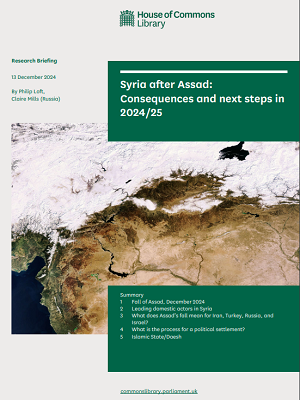
The British Parliament's report released on Friday, December 13, 2024, entitled "Syria after Assad: Consequences and Next Steps in 2024/25" outlines the implications of the fall of Bashar al-Assad's government in Syria, focusing on the following key aspects:
The fall of Assad: In November/December 2024, the government of Bashar al-Assad fell militarily. The report states that Hayat Tahrir al-Sham (HTS) mobilized in northern Syria and took control of large areas, including Hama and Homs. Other factors contributed to Assad's fall, including the weak loyalty of his forces, the limited impact of economic sanctions, and severe damage to infrastructure.
The humanitarian situation: The humanitarian situation in Syria has worsened as the conflict continues, with millions of refugees and internally displaced people. The report highlights the need of Syrian citizens for humanitarian assistance, especially food.
Local and foreign actors: The report examines the main actors in Syria, such as Hayat Tahrir al-Sham, the Syrian National Army, and the Syrian Democratic Forces, and looks at the positions of the UK, EU, US, Russia, Turkey, and Israel towards these groups.
Political negotiations: The report mentions UN and EU efforts to find a political settlement in Syria and work towards a political transition. Key recommendations include the formation of a transitional government and elections.
ISIS: ISIS continues to pose a threat, despite the loss of territory. The report mentions efforts to combat ISIS and cooperation between U.S. and Iraqi forces.
Conclusion: The report provides a comprehensive picture of the complex situation in Syria, highlights the main challenges facing the country after the fall of Assad, and addresses the implications for the region and the world.
Fill in the fields, and we will contact you to complete the submission process.
comments