



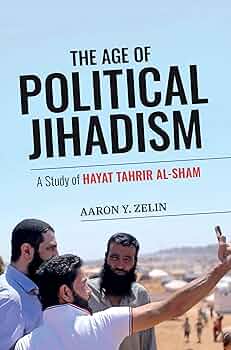
Aaron Y. Zelin's book, The Age of Political Jihad. Aaron Y. Zelin's "The Age of Political Jihad: A Study of Hayat Tahrir al-Sham"
The Age of Political Jihadism: A Study of Hayat Tahrir al-Sham
The evolution of Hay'at Tahrir al-Sham (formerly known as Jabhat al-Nusra) from a branch of al-Qaeda in Syria to a more politically oriented entity within the jihadi (extremist) spectrum. The author argues that HTS, under the leadership of Abu Muhammad al-Joulani, has undergone a significant transformation from a traditional extremist armed group focused on global goals to an entity primarily focused on local governance and political engagement. This shift marks the beginning of a new era of "political jihad." The book also analyzes the leadership of HTS, represented by Abu Muhammad al-Joulani, and its relations with other groups
Key themes and insights:
1. The evolution and transformation of Hayat Tahrir al-Sham: The book traces the evolution of the group, its separation from al-Qaeda, and its transformation into a local governing entity. It highlights the group's orientation towards political pragmatism and its quest to gain legitimacy internationally, and contrasts this pragmatic approach with the group's previous focus on global jihad and its more radical actions.
2.Political Jihad: The book discusses the concept of "political jihad," in which (extremist) armed jihadist groups prioritize local governance and political power over cross-border terrorism. The trajectory of HTS is presented as a prominent example of this evolving trend within (extremist) armed jihadist movements. Zelin analyzes how HTS uses political engagement to gain legitimacy and consolidate its control over territory.
3. The author talked about the future implications of HTS, including its assertion that it seeks political engagement and aspires to assume power away from jihadist (extremist) ideological slogans with a totalitarian and global dimension, but it will remain highly questionable if its classification remains and its behavior is monitored at the level of leaders and fighting groups.
4. Hayat Tahrir al-Sham and the West: Zelin analyzes the group's attempts to reach out to Western governments and its quest to differentiate itself from groups like ISIS, while navigating alliances with local and international actors.
5.Policy Dilemma: Zelin explores the complex policy questions regarding whether HTS should be removed from the U.S. terrorist list. The group presents a unique case where it now claims to oppose global terrorism while retaining extremist beliefs.
6. HTS's approach to governance: The book discusses the group's transition from global jihadism to local governance, its management of the areas under its control, and the formation of the civilian-led Syrian Salvation Government.
7. Jihad strategy: The author places HTS within the broader context of (extremist) jihad movements, highlighting its adoption of more politically-oriented tactics compared to other extremist groups.
8. Governance in Idlib: Zelin details HTS's governance strategies in the Idlib region, including its relationship with the Syrian Salvation Government. He discusses the group's efforts to provide basic services, such as education and healthcare, and its attempts to establish an effective judicial system based on its interpretation of Islamic law. But it also highlights its authoritarian tendencies and human rights violations, including suppression of dissent, arbitrary arrests, and torture.
9. The question of terrorist designation: The book addresses the central question of whether HTS still meets the criteria for designation as a Foreign Terrorist Organization (FTO) by the U.S. State Department. While Zelin acknowledges HTS's past ties to al-Qaeda and its ongoing problematic behavior, he notes that its current focus on local governance raises questions about the appropriateness of terrorist designation. He explores alternative sanctions regimes and identifies potential conditions for de-designation, such as allowing independent prison inspections, releasing political prisoners, and forming a national reconciliation commission.
10. External Operations and Influence: Although the book focuses mainly on HTS's activities inside Syria, it also examines the group's external operations and influences. Zelin notes that although HTS broke away from al-Qaeda, it still draws inspiration from historical jihadi (extremist) figures and shows support for groups such as the Taliban and Hamas. He analyzes the implications of this ongoing interaction with the broader jihadist movement on HTS's future trajectory and its relationship with the West.
11 One of the author's criticisms is that HTS has continued to propose extremist ideas and target civilians in regime areas. It has also allowed terrorist organizations to operate in its areas, which raises researchers' doubts about the sincerity of its transformation, and therefore its attempt to reclassify itself is part of ignoring the victims of its violence and past human rights violations, according to the author.
12. The book, released in 2023, spoke of a strategic dilemma for Western governments and experts about dealing with the HTS model between rehabilitation and the risk of legitimizing a group with a violent history.
13 According to the author, Turkey's adoption and support for HTS has further complicated the situation, as it plays the role of a regional ally and protector of the HTS experiment, and Turkey's support for HTS further complicates the situation, as it plays the role of a regional ally and provides protection to the organization.
14. One of the issues raised by the author is the dilemma of internal divisions within the movement, including Hayat Tahrir al-Sham, especially with those who remain loyal to al-Qaeda or reject the idea of "local jihad"
15. Adding to the level of defections was HTS's suppression of its jihadist (extremist) rivals, especially the Hurras al-Din organization.
Conclusion:
The Age of Political Jihad provides a detailed and balanced account of HTS's transformation and its implications for the future of armed jihadist (extremist) movements. Zelin provides valuable insights into the complex dynamics in Syria and the challenges posed by groups such as HTS, which blends jihadist (extremist) ideology with pragmatic political engagement. The book concludes by noting that "the era of political jihad has begun," highlighting the need to rethink counterterrorism strategies to deal with groups that focus on local control rather than international attacks.
Fill in the fields, and we will contact you to complete the submission process.
comments